

Most people step on a scale and assume the number tells them something meaningful. It doesn't. Weight alone cannot distinguish between fat and muscle, cannot detect dangerous visceral fat accumulating around your organs, and cannot tell you whether your bones are quietly losing density. A DEXA scan can do all three — and at SORCE Health in Fort Lauderdale, it is the foundation of how we build your personalized longevity strategy.

A DEXA scan — short for Dual-Energy X-ray Absorptiometry — is a clinical-grade imaging test that uses two low-dose X-ray beams to measure your body's three core components: bone mineral density, fat mass, and lean muscle mass. It is widely recognized as the gold standard for body composition analysis, with an accuracy margin of just ±1–2% — far exceeding other common methods like bioelectrical impedance (InBody), which carries a ±3–5% margin of error and is highly sensitive to hydration and meal timing.
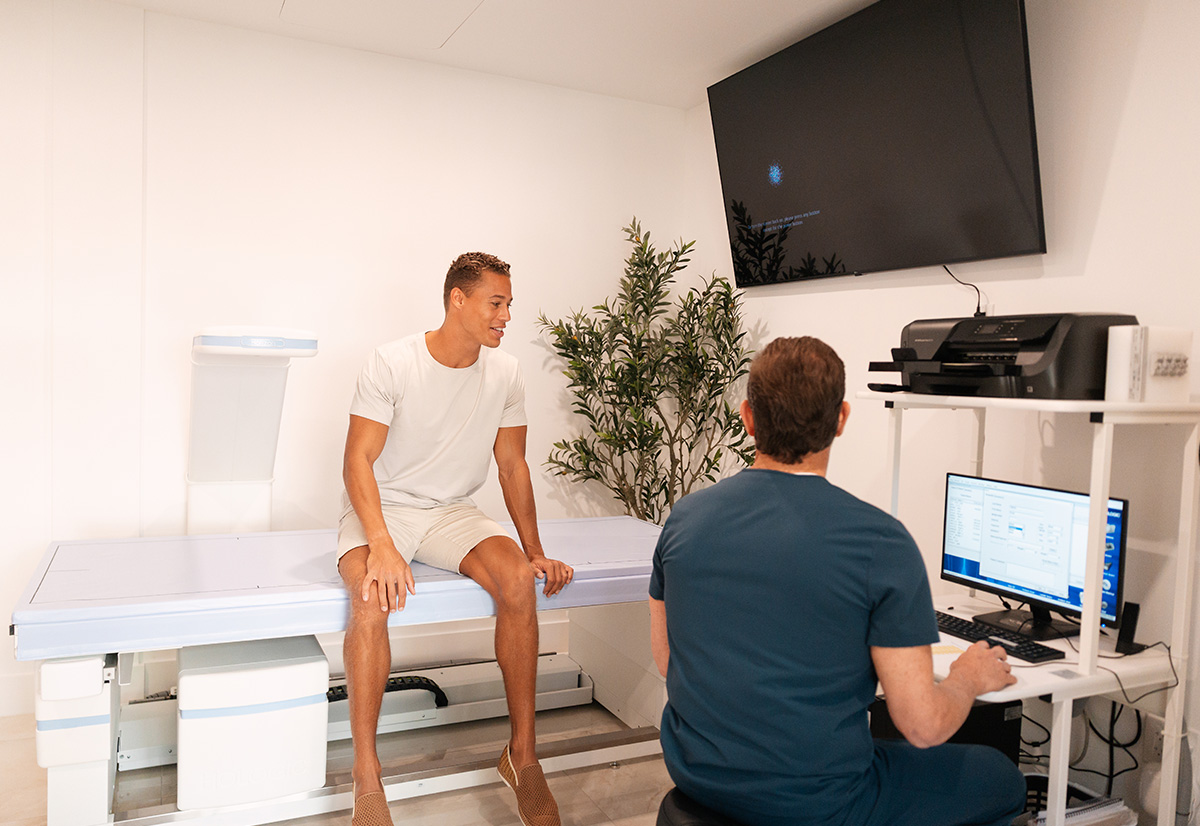
The scan is fast, non-invasive, and requires no preparation. You simply lie still on an open table while the scanner passes over your body — the entire process takes roughly 10–15 minutes. The radiation exposure is minimal, equivalent to less than one day of natural background radiation.
A DEXA scan goes far beyond a single body fat percentage. At SORCE Health, our DEXA+ scan provides a detailed, segmental breakdown of your body composition — customized based on your individual health profile and risk factors. Here is what the scan reveals:
Your bone mineral density is reported as a T-score and Z-score, which compare your bone strength against peak-density norms and age-matched peers respectively. Low BMD is the definitive diagnostic marker for osteopenia and osteoporosis — conditions that increase fracture risk significantly, and that often develop silently for years before becoming a clinical problem. At SORCE, we measure BMD proactively, not reactively.
Visceral fat — the fat stored deep in the abdominal cavity around your organs — is one of the strongest predictors of cardiovascular disease, metabolic syndrome, type 2 diabetes, and chronic inflammation. DEXA is the only practical method outside of MRI for accurately quantifying visceral fat. A person can appear lean on the outside and carry dangerous levels of visceral fat internally — a risk that a scale, BMI calculation, or InBody scan will simply miss.

The scan measures lean mass regionally across your arms, legs, and trunk. A key derived metric is your Appendicular Lean Mass Index (ALMI) — the muscle mass in your arms and legs relative to your height. ALMI is the clinical standard for identifying sarcopenia (age-related muscle loss), which is independently associated with frailty, poor metabolic health, and significantly reduced longevity. Low ALMI is a serious risk factor — one that is entirely invisible on a standard weight or BMI measurement.
The scan provides a complete regional breakdown of fat mass across your body — including android (waist/abdomen), gynoid (hips), and limb measurements. This gives your physician a precise map of where fat is accumulating, not just how much of it exists in total.
Not all body composition measurements are equal. Here is how DEXA compares to the most common alternatives:
Who Should Get a DEXA Scan in Fort Lauderdale?
A DEXA scan is valuable for a wide range of patients. At SORCE Health, we recommend it as part of your baseline assessment if you fall into any of the following categories:
A DEXA scan at SORCE Health is not a standalone test. It is one piece of a comprehensive diagnostic picture that your physician integrates with your full health profile — including extensive blood panels, VO₂ max testing, epigenetic age analysis, genomic sequencing, microbiome analysis, and coronary CT angiography with AI calcium scoring.
Your DEXA results directly inform your personalized treatment plan across the full range of SORCE services. Low bone density? We address it through hormone optimization, targeted peptide therapy, and evidence-based lifestyle protocols. High visceral fat? We build a metabolic intervention strategy around your real data. Muscle loss detected through low ALMI? We design a precision plan to rebuild lean mass before it becomes a clinical problem.
This is precision medicine — not guesswork. Every protocol at SORCE is built around your biology, not population averages.

The process at SORCE Health is straightforward:
Yes. The radiation exposure from a whole-body DEXA scan is extremely low — equivalent to less than one day of natural background radiation. It is far lower than a standard chest X-ray and is considered safe for regular, periodic use.
At SORCE Health, we typically recommend an annual DEXA scan to track changes in bone density, muscle mass, and visceral fat over time. For patients on active treatment protocols — such as hormone optimization, GLP-1 therapy, or structured training programs — more frequent scans may be recommended to monitor progress.
A traditional bone density scan focuses specifically on the hip and lumbar spine to assess fracture risk. A full-body DEXA scan — as performed at SORCE Health — includes bone mineral density assessment plus a complete body composition analysis, covering fat mass, lean muscle mass, visceral fat, and regional distribution.
Yes. Bone mineral density readings from a DEXA scan are reported as T-scores and Z-scores. A T-score of -2.5 or below indicates osteoporosis. A score between -1.0 and -2.5 indicates osteopenia — reduced bone density that is a precursor to osteoporosis. Early detection through DEXA allows for intervention before fracture risk becomes severe.
MRI and CT scans are primarily used for imaging soft tissue and detecting specific pathology. A DEXA scan is purpose-built for measuring body composition and bone density with clinical precision. It is faster, uses far lower radiation than a CT, and provides quantitative body composition data that MRI and CT do not generate in the same way.
SORCE Health offers DEXA+ scanning as part of our advanced diagnostics program in Fort Lauderdale, Florida. Our DEXA scans are physician-supervised and integrated into a comprehensive longevity assessment — not offered as an isolated test without clinical context.
Your body is changing every year. The question is whether you are measuring it precisely enough to do something about it. A DEXA scan at SORCE Health gives you the data to act — on bone health, on visceral fat, on muscle mass — before any of these become the problem you are trying to fix.
Book a consultation with our team to discuss your DEXA+ scan and full diagnostic assessment.