


A new category of consumer health products has made bloodwork more accessible than ever. Function Health, Superpower, InsideTracker, and a growing list of subscription dashboards offer 100+ biomarker panels for a few hundred dollars a year. Order online, get blood drawn, log into an app, and a color-coded report appears alongside AI-generated recommendations.
It is a real advance — and for many people, a useful one. But anyone considering one of these services should understand what they are actually buying, and what they are not.
This post compares the dashboard model with a physician-read panel, including the SÖRCE Blueprint, and explains where each approach fits.
Dashboard companies test a lot of markers — often more than 100. For someone who has never had advanced biomarkers measured, a single subscription can return a meaningful baseline across cardiovascular, metabolic, hormonal, thyroid, and inflammatory dimensions.
The dashboard model removed several barriers at once: no referral, no in-person visit required, no insurance argument, no waiting for a specialist. Order, draw, view. For self-directed adults who want to see their numbers, that accessibility matters.
Annual or quarterly retesting allows patients to track movement on individual markers across years. For someone running a multi-year optimization effort, that longitudinal view is genuinely useful.
At roughly $499 per year for the most popular service in the category, the per-marker cost is low. For patients whose goal is broad self-monitoring, the math works.
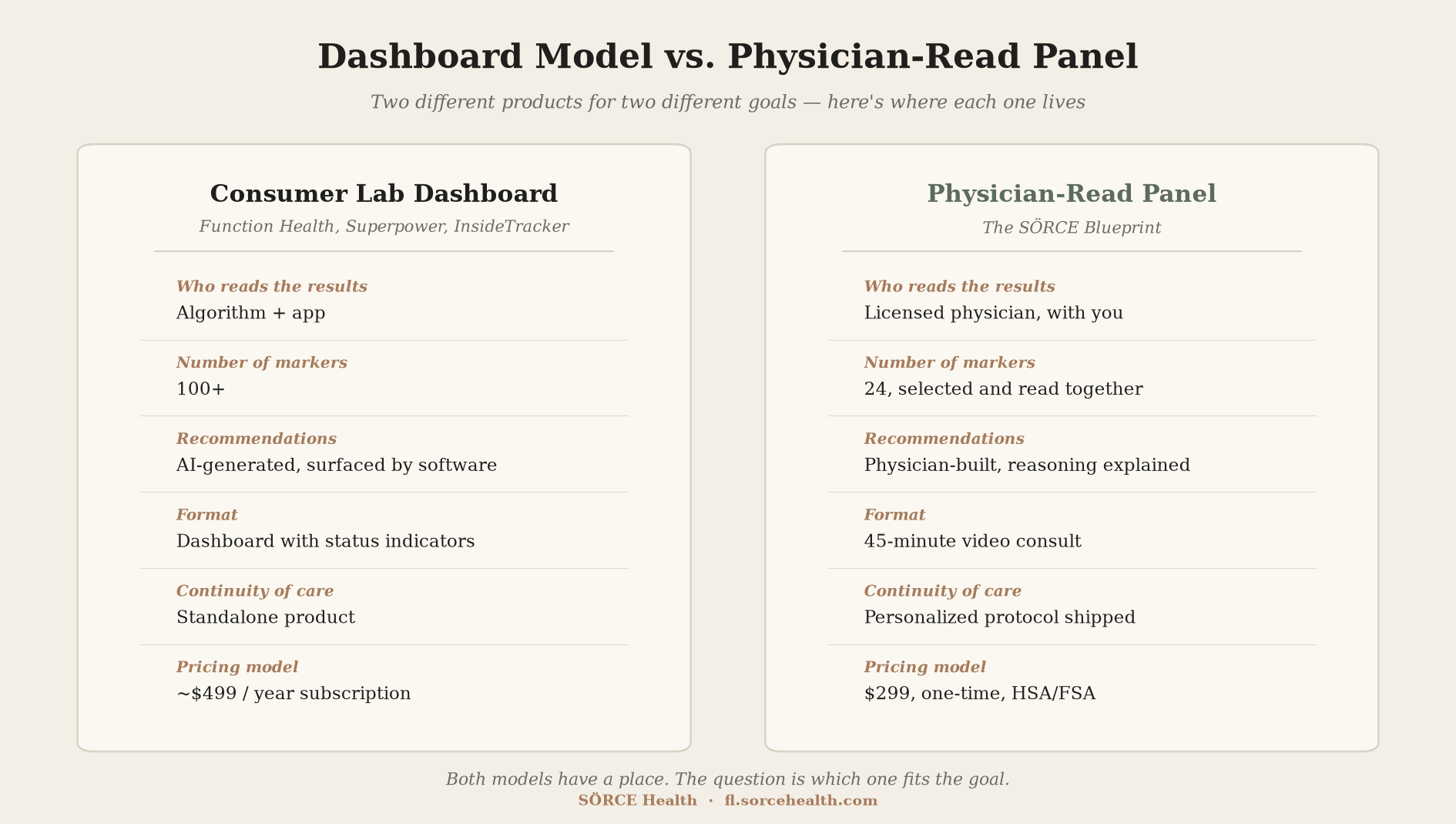
The defining feature of the dashboard model is that a physician does not sit down with the patient and walk through results. Reports are generated algorithmically. Recommendations are surfaced by software. Some services offer optional add-on calls, but the core product is the app — not the consult.
This is not a small detail. The interpretation of a biomarker depends heavily on context: the patient's history, symptoms, training load, sleep, medications, family history, and goals. An algorithm can flag a value outside a range. It cannot weigh trade-offs, ask follow-up questions, or build a plan that fits a real life.
Reading a panel well means reading it as a whole. One marker rarely tells the story — patterns across several markers usually do. A dashboard tends to present markers individually, with red/yellow/green status indicators. A physician trained in longevity medicine reads the panel as a system, looking for what the combination of values suggests about the patient's physiology overall.
A dashboard tells the patient what to do. A physician explains why — what each recommendation is based on, what the trade-offs are, what could go wrong, and what to monitor. That reasoning is what allows patients to make informed decisions about their own care, and to adjust as their situation changes.
When a marker is unusual, the question is rarely "what does this number mean in isolation?" It is "what should I do next, and in what order?" That decision involves clinical judgment — the kind of judgment a licensed physician is trained to provide and an algorithm is not.
Most dashboard products are designed as standalone services. They do not coordinate with the patient's broader care, do not write referrals, and do not follow up on findings. If a panel surfaces something that warrants attention, the next step is the patient's responsibility.
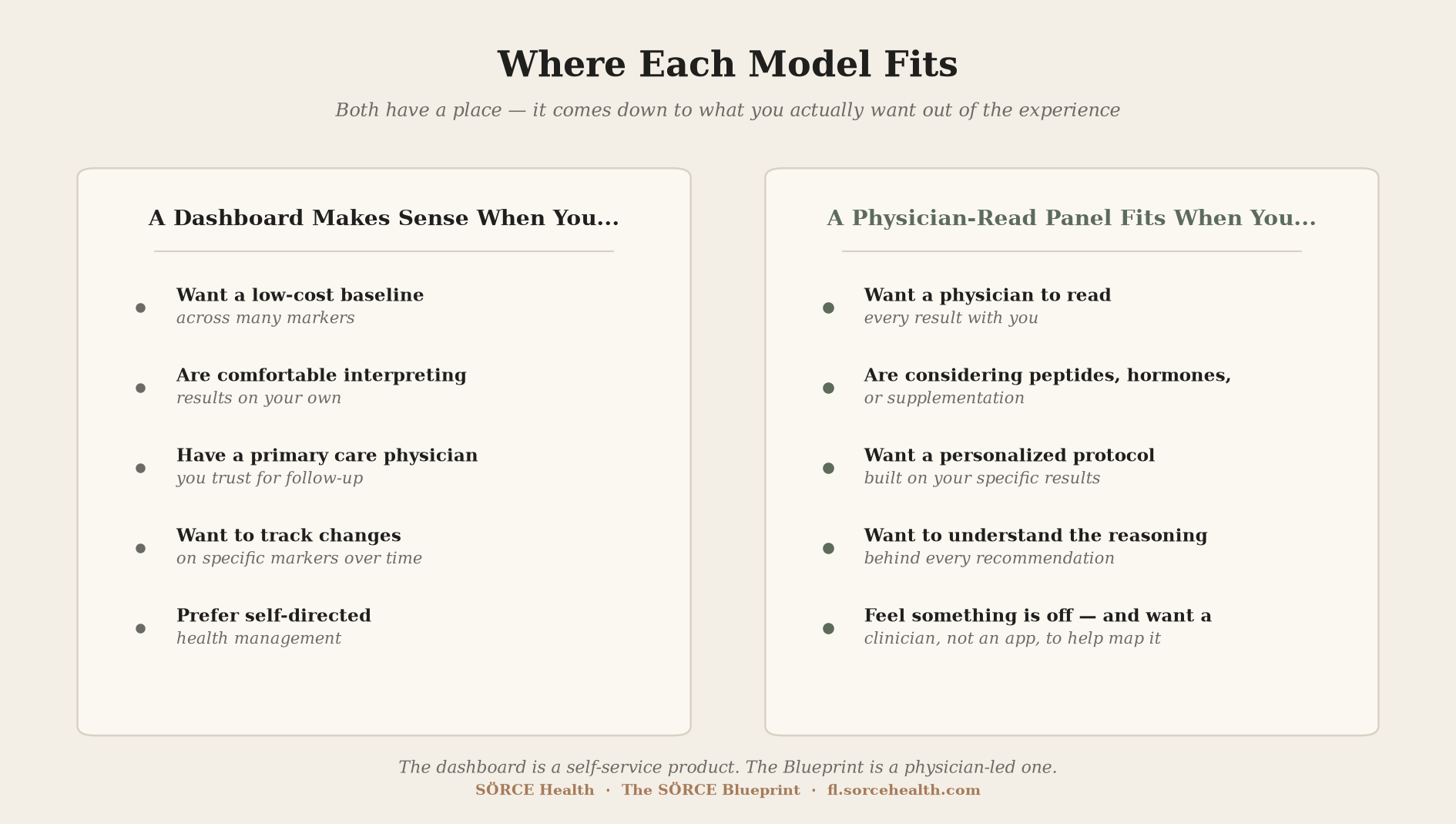
The dashboard model can be a strong fit for patients who:
For these patients, an annual subscription is a useful tool.
A physician-read panel tends to fit patients who:
These patients are often less interested in the volume of markers and more interested in the depth of the conversation.
The SÖRCE Blueprint is built around the consult, not the dashboard. The structure:
The Blueprint is not a competitor to the dashboard model in the strict sense — the two are built for different goals. The dashboard is a self-service product. The Blueprint is a physician-led one.
Not necessarily. The value of a panel is shaped by how well it is read, not only by how many markers it includes. A 24-marker panel reviewed in detail by a physician can produce more actionable insight than a 100-marker dashboard reviewed by an algorithm — depending on the patient's goals.
Yes. Some patients use a dashboard subscription for ongoing self-monitoring and a physician-read panel like the SÖRCE Blueprint when they want a deeper, physician-led read at a specific decision point — for example, before considering hormones, peptides, or a significant change in protocol.
The 24-biomarker SÖRCE Blueprint panel covers cardiovascular, metabolic, hormonal, thyroid, and inflammatory/aging markers — including ApoB, Lp(a), fasting insulin, and a full thyroid picture. The full marker list is reviewed during the physician consult.
No. It is a one-time $299 purchase. There is no recurring charge. Patients can choose to retest in the future if they want a follow-up read, but no subscription is required.
At any LabCorp location. The Blueprint is virtual — no kits to mail, no clinic visit required for the draw. Patients near Fort Lauderdale may come into the SÖRCE clinic for the draw or add an optional in-person DEXA scan.
The dashboard model is a real step forward for accessibility. It put advanced biomarker data into the hands of self-directed patients who, a decade ago, would have had to argue with their insurance to get a fraction of the same panel. That is a meaningful change.
What dashboards do not do — by design — is replace the conversation with a licensed physician. For patients who want that conversation as the center of the experience, a physician-read panel is the alternative.
The SÖRCE Blueprint is built around that idea: fewer markers, more depth, every result read with a physician, and a personalized protocol shipped to the patient's door. The consult is the product.
SÖRCE Health is an advanced longevity clinic in Fort Lauderdale, Florida. The SÖRCE Blueprint is a one-time, physician-led panel and consult. Medical consultation required. Individual results vary. This article is for educational purposes and is not medical advice.